The ten commandments of good design.
Dieter Rams’ ten principles are more than forty years old and still the best design brief we know. Here they are, with the little illustrations we drew for them in 2015, and what they mean for brands today.

Listen to this article
5 min · Read aloud by your browser
5:00
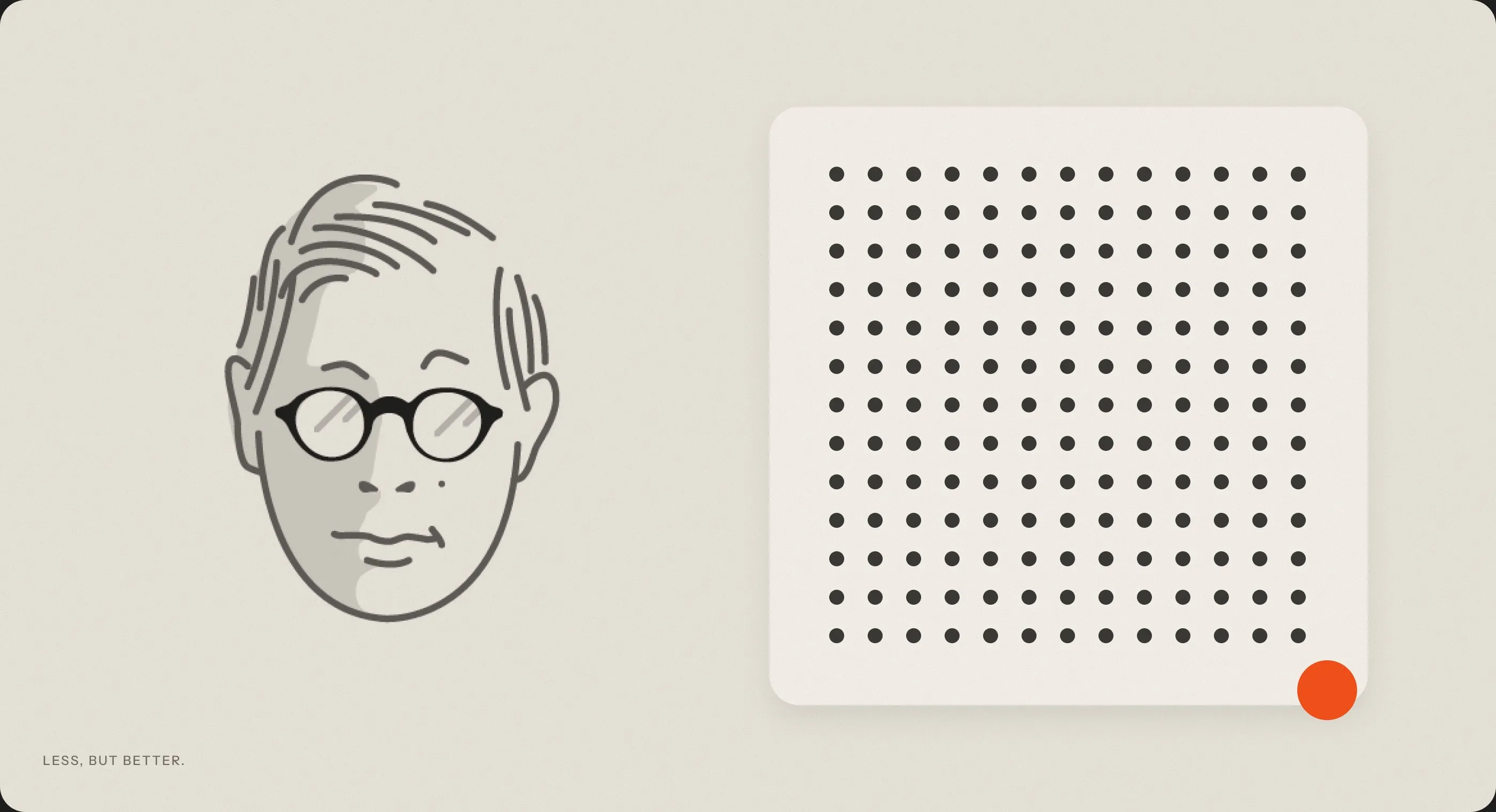
In the early 1980s, Dieter Rams grew uneasy about the world around him, a confusing jumble of forms, colours and noises. Knowing he’d added to it himself, he asked a simple question: is my design good design? Good design can’t be measured, so he set out ten principles instead.
We first shared them on the journal in 2015, with a small illustration for each one. Ten years and a lot of projects later, they’re still pinned up in the studio, so we’ve given the post a refresh.
The ten principles.
Principles by Dieter Rams, shared by Vitsœ.
Illustrations by Matt Hamm, 2015.
- 01

Good design is innovative.
Innovation should move with technology, never for its own sake. Use new tools to do something better, not just something new.
- 02

Good design makes a product useful.
Things are bought to be used. Design should serve function, feeling and looks, and lose anything that gets in the way.
- 03

Good design is aesthetic.
What we use every day shapes how we feel. Only well-made work can be truly beautiful.
- 04

Good design makes a product understandable.
It shows how a product works. At its best it speaks for itself, no manual required.
- 05

Good design is unobtrusive.
Products are tools, not ornaments. Design should be restrained and leave room for the people using it.
- 06

Good design is honest.
No overselling, no inflated claims, no promises the product can’t keep.
- 07

Good design is long-lasting.
It skips trends, so it never looks dated, and it’s made to be kept rather than thrown away.
- 08

Good design is thorough down to the last detail.
Nothing arbitrary, nothing left to chance. Care in the details is a form of respect.
- 09

Good design is environmentally friendly.
Design can save resources and cut physical and visual pollution across a product’s whole life.
- 10

Good design is as little design as possible.
Less, but better. Focus on what matters and lose the rest.
Why we still come back to them.
Every brand, website and design system we make gets measured against these principles at some point. They’re a useful gut check when a project starts to drift: is this useful, is it honest, is it the least we can do to get the idea across?
Less, but better, for brands.
For a brand, ‘as little design as possible’ doesn’t mean bland. It means one clear idea, a focused palette, a small set of typefaces and a system that does the heavy lifting, so every new page, booth or campaign looks right without being reinvented.
“Less, but better.”
Honest and long-lasting.
Trends move fast online. Brands built on honest positioning and careful craft outlast them, and save their owners from an expensive rebrand every couple of years. That’s the kind of work we want to make.