Your brand guidelines need to work for AI now.
Sales decks from Copilot, social posts from ChatGPT, images from Midjourney. Your team is making more content than ever, and most of it is made with AI. That’s great for speed, but without a brand system it can actually read, everything slowly drifts towards the same beige average.

Listen to this article
5 min · Read aloud by your browser
5:00

A couple of years ago, most of what a company put out into the world went past a designer or a marketer first. Not any more. Sales put together their own decks. Product managers write release notes with ChatGPT. Someone in the events team makes a banner in Canva with an AI-generated background. Everyone is a content creator now, and most of them have an AI assistant doing half the work.
We think that’s mostly a good thing. It’s faster, it’s cheaper and it frees people up. But we keep seeing the same side effect: the brand slowly goes soft around the edges. The colours are nearly right. The tone sounds like every other company’s blog. The images have that glossy, slightly uncanny look that says “made by AI” from across the room.
The problem isn’t the AI.
AI tools are very good at filling gaps. Ask one to write a LinkedIn post or design a slide and, if it doesn’t know your brand, it fills the gaps with the average of everything it’s seen. Which is exactly what you don’t want a brand to be.
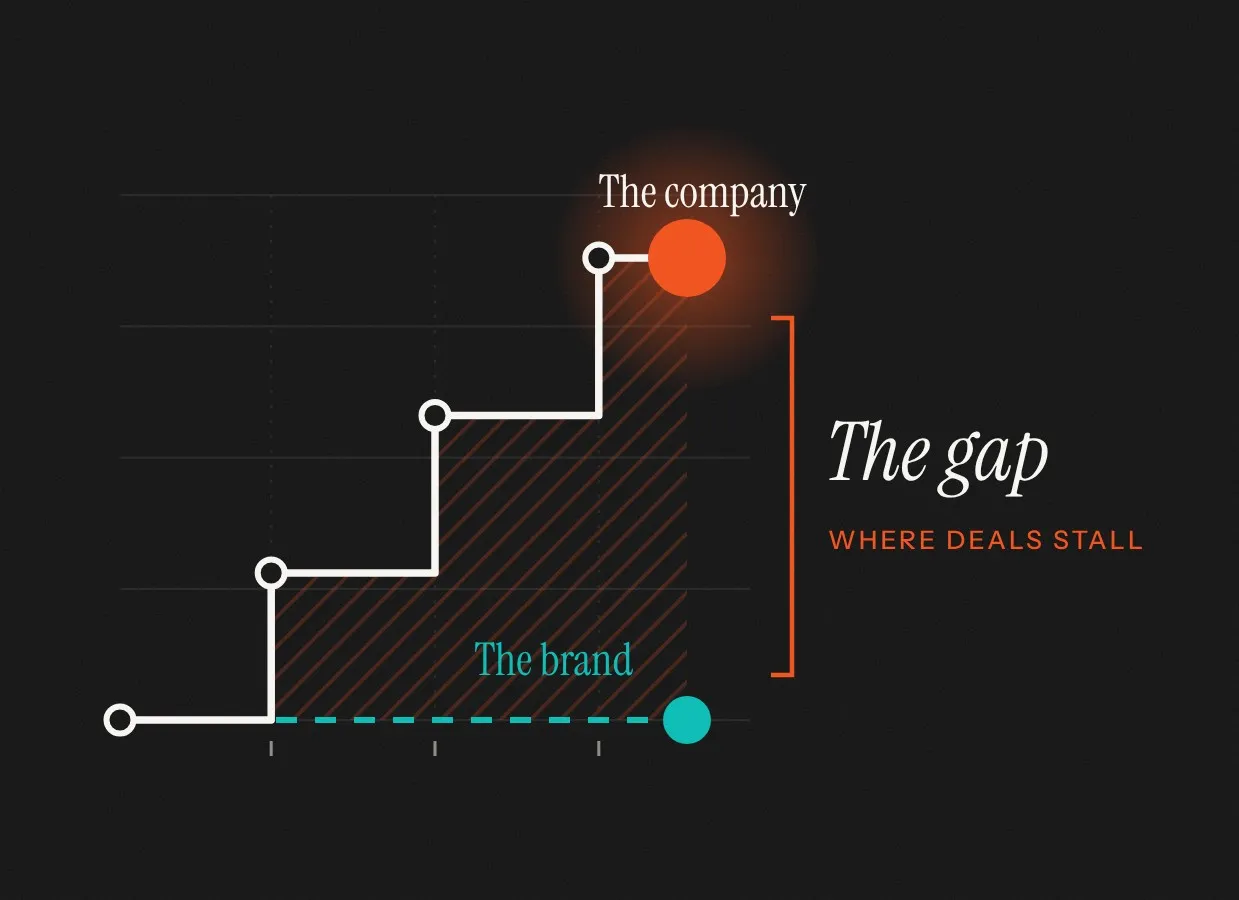
Most brand guidelines weren’t built for this. They’re a 60-page PDF made for designers, full of logo exclusion zones and print colour specs. Nobody in sales has read it, and an AI tool can’t do much with it either. So the brand only really lives in the heads of a few people, and everything made without them drifts.
“AI doesn’t have taste. Your brand system has to supply it.”
Make the brand the source of truth.
The fix is to treat your brand as the source of truth for everything your company makes, whether a person or a machine is making it. That means writing the brand down in a form both can actually use, then putting it right where the work happens.
It’s the same idea we wrote about in Your logo isn’t doing the heavy lifting. The system around the logo is what does the work. With AI in the mix, that system just needs to be a lot more explicit.
People still design the brand.
To be really clear, this isn’t about using AI to design your brand. The positioning, the ideas, the craft and the taste still come from people who know what they’re doing. We use AI as a support tool, not the driver, and that hasn’t changed.
What has changed is what happens after the brand is designed. AI makes more of whatever you give it. Give it a clear, well-documented brand and it scales that brand beautifully. Give it a logo and a PDF and it scales the average. A weak brand used to be a problem on a few pieces of work. Now it’s a problem on thousands.
We’ve been doing it ourselves.
When we rebuilt our own website this autumn, we did it in about a week, with AI tools doing a lot of the heavy lifting on the build. The only reason that worked is that the brand was pinned down first: the colours, the type, the spacing, the tone and the rules for using them. Every page that came out of the process looked and sounded like us, because there was a system to follow.
That’s the same thing we now build for clients. Alongside the identity and the design system, we package the brand up so the tools your team already uses can follow it too.
Where to start.
You don’t need to rebuild everything at once. Three small steps make a big difference:
- Write down your tone of voice, with examples. A page of “we say this, not that” beats ten pages of adjectives.
- Turn your colours and type into tokens. One set of exact values, shared everywhere, so nothing gets eyeballed.
- Write one set of brand instructions for AI and share it with the team. Put it in a shared ChatGPT or Claude project so everyone starts from the same place.
Do those three and you’ll notice the difference within a week. And if you’d like a hand with the rest, it’s exactly the kind of thing we love getting stuck into.